 English
 中文
中文 Pусский
 Español
 Português
 عربى
عربى

How Accurate Is a Digital Display Time Relay?
You've seen it happen. A mechanical timer set for 10 seconds starts delivering 11 seconds after six months. Then 12 seconds after a year. The machine cycle drifts. Production quality suffers. Someone adjusts the timer, and the cycle starts over — but the drift continues.
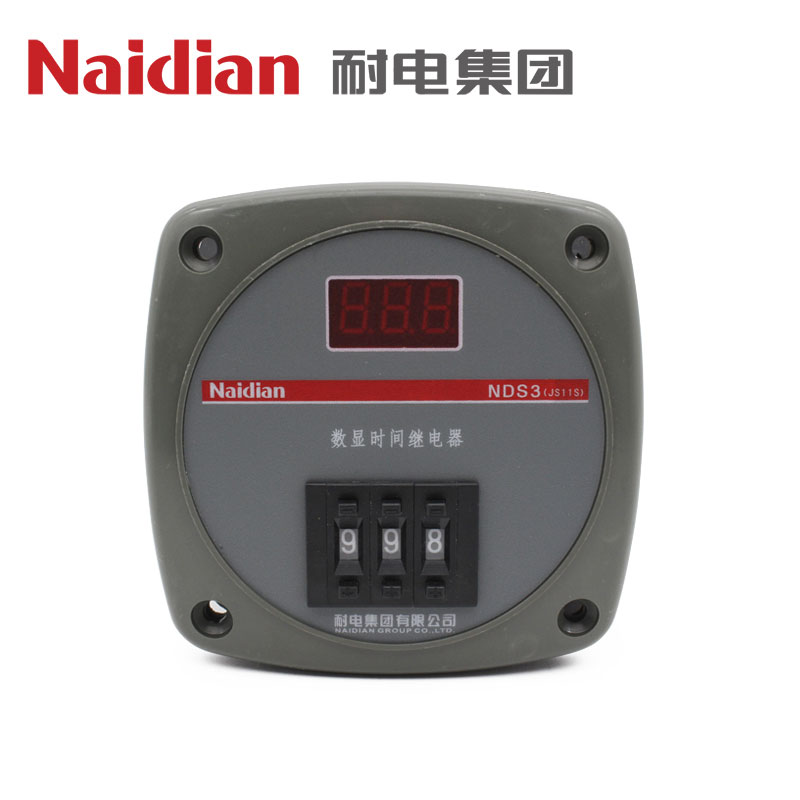
A digital display time relay solves this problem. It uses an industrial single-chip microcomputer as the main core device for precise time control. The timing is crystal-controlled — the same technology used in watches and computers. Accuracy is typically within ±0.1% of the set time, and it doesn't drift as the relay ages. The NDS3(JS11S) and DH11S series offer timing ranges from 0.01 seconds to 99 hours 99 minutes with LED digital display for precise setting. This guide covers how accurate digital display time relays are, why they maintain accuracy over time, and how they compare to mechanical alternatives.
What determines timing accuracy
The accuracy of a digital display time relay comes down to its internal timing source. Understanding this helps you appreciate why digital relays outperform mechanical timers.
Crystal-controlled timing — the digital advantage
Digital display time relays use a crystal oscillator as the timing reference. A quartz crystal vibrates at a precise frequency when voltage is applied. The microcomputer counts these vibrations to measure time. This is the same technology used in watches, computers, and smartphones. The timing is consistent across temperature changes and supply voltage variations.
Single-chip microcomputer — the counting engine
The microcomputer receives the crystal signal and counts the oscillations to determine elapsed time. It drives the LED display and controls the relay output. Because the counting is electronic, there are no moving parts to wear or drift. The accuracy is inherent to the design — not something that degrades over time.
Typical accuracy specifications
Digital display time relays typically achieve accuracy within ±0.1% of the set time. For a 10-second delay, that's ±0.01 seconds. For a 1-hour delay, that's ±3.6 seconds. Some high-precision models achieve ±0.05% or better. In contrast, mechanical timers can drift 5-10% over their service life — and that drift increases as the motor and gears wear.
Digital vs. mechanical — the accuracy comparison
The difference between digital and mechanical timing becomes clear when you look at how each technology maintains accuracy over time.
| Factor | Digital Display Time Relay | Mechanical Timer |
|---|---|---|
| Timing source | Crystal oscillator | AC motor and gear train |
| Accuracy | ±0.1% or better | 5-10% drift over life |
| Consistency | Same from day one to year ten | Degrades with motor wear |
| Temperature effect | Minimal | Varies with temperature |
| Voltage effect | Minimal — regulated internal supply | Affects motor speed |
| Display accuracy | Exact number on LED | Approximate dial marking |
Why mechanical timers drift
Mechanical timers use a synchronous motor that rotates at a speed proportional to the AC line frequency. As the motor ages, bearings wear, lubrication thickens, and the motor slows. The gear train also wears, introducing backlash and timing errors. A timer that was accurate when new can be off by seconds per cycle after a few years of continuous operation.
Why digital timers stay accurate
Digital display time relays have no moving timer components. The crystal oscillator doesn't wear. The microcomputer doesn't age. The timing accuracy is the same on the first cycle as it is on the millionth. For applications that run 24/7 — motor controls, conveyor systems, process timing — this consistency is what makes digital relays the preferred choice.
The real-world impact of accuracy
Consider a conveyor system that needs a 30-second delay between cycles. A mechanical timer that drifts 5% delivers 31.5 seconds after a year — and the production line slows down. A digital timer delivers 30 seconds — every cycle, every day, every year. The difference may seem small, but over thousands of cycles, it adds up to lost production and inconsistent quality.
How accuracy affects your application
Timing accuracy isn't just a specification — it affects how your equipment performs and how reliable your production is.
Motor starting sequences
Motors often need precise delays between starts to prevent inrush current spikes. A timer that drifts can cause multiple motors to start simultaneously, tripping breakers or overloading generators. Digital display time relays ensure that starting sequences happen on schedule — every time.
Process control and sequencing
Manufacturing processes rely on precise timing between steps. If the timing drifts, the process drifts. Digital display time relays maintain the timing accuracy that process control requires. You set the time once, and it stays set.
Equipment protection
Many equipment protection circuits rely on timing — such as pump run-on delays after shutdown, or cooling fan delays. A timer that drifts can cause equipment to start or stop at the wrong time, leading to unnecessary wear or even damage. Digital timing ensures that protection sequences operate as designed.
Questions control engineers ask about timing accuracy
Q: How accurate is a digital display time relay?
A: Digital display time relays typically achieve accuracy within ±0.1% of the set time. For a 10-second delay, that's ±0.01 seconds. For a 1-hour delay, that's ±3.6 seconds. The accuracy is consistent across temperature changes and supply voltage variations.
Q: Does timing accuracy degrade over time?
A: No. Digital display time relays use a crystal oscillator that doesn't wear. The microcomputer counting circuit doesn't age. The timing accuracy is the same on the first cycle as it is on the millionth. In contrast, mechanical timers drift as the motor and gears wear.
Q: What affects the accuracy of a digital display time relay?
A: Digital display time relays are designed to be highly stable. The crystal oscillator provides a consistent frequency across temperature changes. The internal power supply regulates voltage, so variations in the supply voltage don't affect timing. For most industrial applications, the accuracy is independent of environmental conditions.
Q: Can I see the set time and elapsed time on the display?
A: Yes. The LED digital display shows the set time when you're programming the relay. During operation, it shows the elapsed time counting down (or up, depending on the mode). This visibility makes setup and troubleshooting fast and straightforward.
How to specify the right digital display time relay for your application
When timing accuracy matters, digital display time relays are the clear choice. The NDS3(JS11S) series offers power-on delay with an LED display, push-button setting, and timing ranges from 0.01s to 99h99min. The DH11S series offers the same digital display with additional configurability. Both are designed for industrial control applications where timing precision and reliability are essential.
Before you specify a timer for your next control panel project, consider your accuracy requirements. If your application can tolerate 5-10% drift, a mechanical timer might still work. But for precision timing, consistent performance, and long-term reliability, digital display time relays are the only choice.
Ready to specify digital display time relays for your control panel? Contact a supplier for product information or a quote on the NDS3(JS11S) or DH11S series. Share your control voltage, timing range, and mounting preference — their team can recommend the right model for your specific application.
