 English
 中文
中文 Pусский
 Español
 Português
 عربى
عربى

What Does a Digital Time Relay Do in Control Systems?
You're designing a control panel or troubleshooting a piece of equipment that needs a timed action. Maybe a motor needs to start after a delay. Maybe a sequence needs a pause between steps. Maybe a process needs a timer to cycle repeatedly. The component that handles these jobs is a time relay.
A digital time relay does exactly what its name suggests: it combines the switching function of a relay with a precision digital timer. You set the time, and the relay switches contacts after the programmed delay. But beyond that simple description, digital time relays offer flexibility — multiple timing modes, wide time ranges, and clear digital displays — that mechanical timers can't match. This guide covers what digital time relays do, where they're used, and how to select the right one for your application.
What a time relay actually does
At its core, a time relay is a timer combined with a relay output. You set a time, and the relay switches after that time has elapsed.
The basic function — time delay switching
A time relay receives a control signal — typically a voltage applied to its input terminals. Once that signal is present, the timer starts counting. When the set time expires, the relay contacts change state — opening or closing the circuit they control. The contacts stay in that state until the control signal is removed or the relay is reset.
Programmable timing modes for different needs
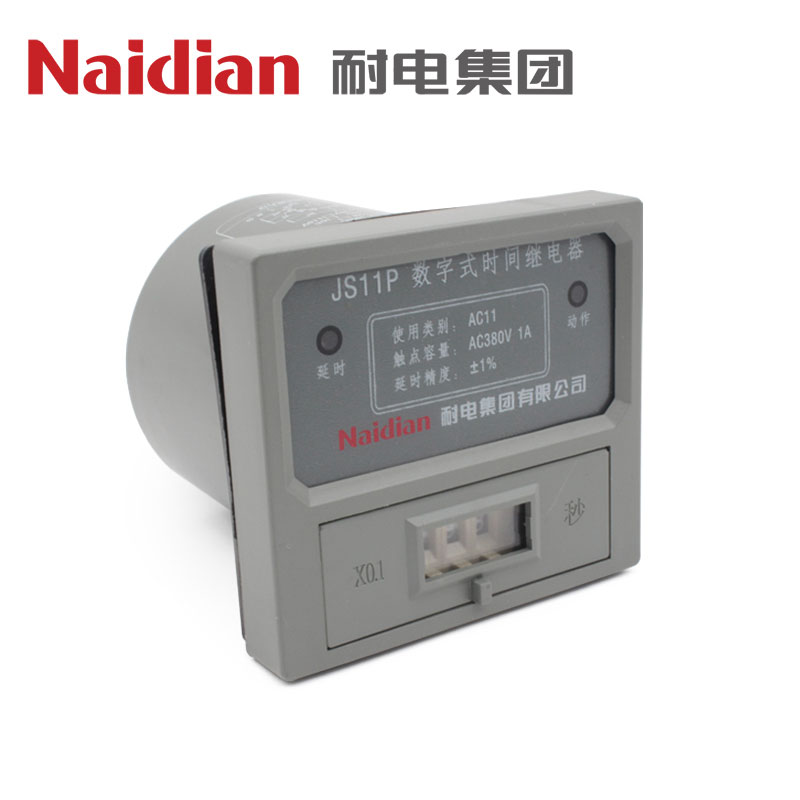
Modern digital time relays, like the NDS4-P (JS11P) series, offer multiple timing modes. The most common modes include:
-
Power-on delay — Timer starts when power is applied. Contacts switch after the set delay.
-
Interval timer — Contacts switch immediately when power is applied, then reset after the set time.
-
Off-delay — Timer starts when power is removed. Contacts switch after the set delay.
-
Cyclic timer — Timer repeats the on/off cycle continuously.
These modes allow one relay to handle a wide range of timing applications.
Digital display for precise setting and monitoring
Unlike mechanical timers that use dials and markings, digital time relays have a clear digital display (typically LCD). The display shows the current time, the set time, and the timing status. Setting the time is precise — you enter the exact number of seconds, minutes, or hours without guesswork.
Where digital time relays are used
Digital time relays are used in many applications — wherever a control system needs a timed action.
Motor control and industrial automation
Motors often need delayed starting or stopping. A power-on delay can prevent multiple motors from starting simultaneously, reducing inrush current. A cyclic timer can control motor-run intervals for conveyor systems.
Lighting and HVAC control
Time relays control lighting sequences — turning lights on or off at set times. HVAC systems use timers to control fan operation, compressor delays, and purge cycles.
Process control and sequencing
Manufacturing processes often require steps to occur in sequence with precise delays between them. Digital time relays provide the timing for these sequences without requiring complex programmable controllers.
Below is a quick reference table for typical applications:
| Application | Timing Mode | Time Range | Purpose |
|---|---|---|---|
| Motor starting | Power-on delay | 1-60 seconds | Prevent simultaneous starts |
| Conveyor cycling | Cyclic timer | Minutes-hours | Intermittent operation |
| Fan delay | Off-delay | 1-10 seconds | Allow cooling after shutdown |
| Lighting control | Interval timer | Minutes-hours | Automatic shutoff |
| Process sequencing | Power-on delay | Seconds-minutes | Sequential step timing |
Features that make a difference
Not all digital time relays are the same. Key features determine how well they fit your application.
Wide time range and precision
The NDS4-P (JS11P) series offers a wide time range — from fractions of a second to tens of hours. The digital setting ensures that time is accurate and repeatable, which is critical for applications where timing precision matters.
Multiple timing functions in one unit
The ability to switch between timing modes — power-on delay, interval, off-delay, cyclic — makes one relay adaptable to many applications. You don't need to stock different relays for different timing functions.
High reliability and long life
Digital time relays have no moving timer components. The timing is electronic, so there's no mechanical wear affecting accuracy. The relay output contacts are rated for the switching load, and the electronics are designed for long service life in industrial environments.
Questions control engineers ask
Q: What is the difference between a digital time relay and a mechanical time relay?
A: A digital time relay uses electronic timing with a digital display for precise setting. A mechanical time relay uses a mechanical timer — often a motor-driven dial — that's less accurate, harder to set, and subject to wear. Digital relays provide better accuracy, more timing modes, and longer life.
Q: What timing modes are typically available?
A: The most common modes are power-on delay, interval timer, off-delay, and cyclic timer. Power-on delay starts timing when power is applied. Interval timer switches immediately and resets after the set time. Off-delay starts timing when power is removed. Cyclic timer repeats the on/off cycle continuously.
Q: How is a time relay connected in a control circuit?
A: A digital time relay has input terminals for the control signal — typically AC or DC voltage — and output contacts that switch the load. When the control signal is applied, the timer starts. When the set time expires, the output contacts change state. The specific wiring depends on the timing mode and the circuit requirements.
Q: What should I consider when selecting a digital time relay?
A: Consider four factors: the required timing mode, the time range, the control voltage, and the contact rating. Ensure the relay's voltage matches your control circuit — typically 24V DC, 110V AC, or 220V AC. The contact rating must handle your load current. The timing mode must match your application's needs.
How to specify a digital time relay
Getting the right digital time relay for your application comes down to four specifications.
Define the timing mode you need. The NDS4-P (JS11P) series offers multiple modes, but not all relays support all modes. Select a relay that includes the mode you need — power-on delay, interval, off-delay, or cyclic.
Determine the time range required. Time relays cover a wide range — from 0.1 seconds to 99 hours. Some applications need short delays (seconds), others need long delays (minutes to hours). Choose a relay with a range that covers your typical applications.
Match the control voltage. Digital time relays are available with different control voltages — 24V DC, 110V AC, 220V AC, and others. The relay's voltage must match your control circuit.
Check the contact rating. The relay's output contacts must handle the load they're switching. Check both the rated current (amps) and the voltage rating. A relay with contacts rated for too low a load will fail prematurely.
How to get the right digital time relay for your control panel
Digital time relays are standard components in control panels, but the right one depends on your application. The NDS4-P (JS11P) series offers multiple timing modes, a wide time range, and a clear digital display — making it suitable for many industrial control applications. Its electronic timing provides accuracy and repeatability that mechanical timers can't match.
Before you specify a digital time relay, define your timing requirements: the mode, the time range, the control voltage, and the contact load. The right relay will provide reliable timing for years, reducing downtime and improving control system performance.
Ready to specify digital time relays for your next control project? Contact a supplier for a quote or technical consultation. Share your timing mode, time range, and control voltage requirements — their team can recommend the right digital time relay for your specific application.
