 English
 中文
中文 Pусский
 Español
 Português
 عربى
عربى

Why does a packaging line jam when the temperature changes by 5 degrees, but a time relay keeps it running for a full shift?
A packaging plant in the Midwest kept experiencing jams at its labeling station. The conveyor belt was drifting out of sync with the label applicator by 30 to 50 milliseconds every few hours. The maintenance team added mechanical limit switches, installed extra photocells, and twice replaced the motor drive. The root cause was not the motor or the sensors. It was a delay circuit that drifted with temperature. The analog timer that controlled the gap between the conveyor‘s motion and the label applicator changed its delay every time the control room warmed up or cooled down. A technician swapped the old timer for a digital time relay with measured repeatability under 5 milliseconds and set the exact 500ms delay. The conveyor and applicator stayed synchronized through the next two shifts, and the jam stopped.
A time relay does not just count seconds. An electronic timer digitizes time. It uses a quartz crystal oscillator for its time base and frequency‑division counting to generate delays with repeatability under 5 milliseconds. The delay ranges from 0.1 seconds up to 9,999 seconds across different models, with contact capacity up to 5A at 250VAC for resistive loads. The same relay can run on AC24V, 110V, 220V, 380V at 50Hz, and DC24V, eliminating the need for separate AC and DC inventory. This guide explains how quartz‑crystal timing ensures stable delay under temperature swings, why 5A contact rating supports direct switching of small motors and solenoids, and where panel vs. guide‑rail mounting reduces control panel build time.
Quartz crystal timing: why a timer that drifts 0.5% with temperature costs you one call per machine per year
An electromagnetic or RC time relay sets its delay by charging a capacitor through a resistor. The charge rate changes with temperature. When the control panel warms up, the delay shortens; when the plant cools overnight, it lengthens. That drift of ±10% or more at the extremes generates timing errors that accumulate over multiple cycles. A packaging line that repeats a 1‑second delay 10,000 times per shift will drift enough in eight hours to misalign the next label.
An electronic time relay built on a quartz crystal oscillator eliminates temperature‑driven drift. It uses quartz crystal frequency division counting to produce standard clock pulses that do not shift with ambient temperature. The repetition error is ≤1%, with certain models achieving ≤±0.02s for high‑precision applications. For a packaging line that runs 20 hours a day, the drift between the start and end of a shift is practically zero. The operator no longer performs a midday timer adjustment.
The digital nature also eliminates the mechanical calibration dial found on analog timers. The operator sets the exact delay through a digital interface or a thumbwheel switch and knows the time is repeatable across every cycle. For a motorized valve that needs to open for exactly 3 seconds after the pump starts, that precision prevents over‑pressurizing the downstream piping.
AC/DC universal input: why a relay that works on 24V DC through 380V AC simplifies panel wiring
A panel builder who stocks three separate relay part numbers—one for 24V DC control circuits, one for 220V AC, and one for 380V AC—runs the risk of grabbing the wrong relay during assembly. The wrong voltage supply either fails immediately (24V DC relay connected to 220V AC) or fails to operate (380V AC relay connected to 24V DC). Both cause production delays.
A time relay that accepts a single unit covering AC24V, 110V, 220V, 380V at 50/60Hz and DC24V from a single part number solves that problem. The operator assigns the voltage at installation. The panel builder stocks one relay for cabinet applications, eliminating the risk of mispicking a voltage‑specific unit. The input voltage fluctuation range is 85% to 110% of the rated value, which accommodates typical industrial power sag without resetting the timer.
The same relay also offers surface panel‑mounting faceplate and 35mm DIN rail mounting options. One relay design adapts to both. For an OEM control panel with limited backplane space, the 35mm top hat rail mount secures the relay without screws. For a retrofit replacement of a failed analog timer inside an existing machine‘s door, the panel‑mount version fits the same cutout.
Delay modes and contact sets: why a motor starter timer and a flashing warning light timer are not the same relay
A machine builder ordering a time relay selects not only the delay range but also the delay mode. Power‑on delay (the relay‘s contacts switch after power is applied) covers most applications. But an HVAC system needs interval delay for defrost cycles, and a motor starter needs star‑triangle start delay to sequence the contactors.
The digital relay family offers multiple delay mode variants within the same housing. Common modes include:
-
Power‑on delay (on‑delay) – Conveyor, label applicator, lighting timer
-
Star‑triangle start – Motor starter with contactor sequencing
-
Repeating cycle (on/off pulsing) – HVAC defrost, pump test, signal flasher
-
Interval (on‑pulse) – Door open holding, temporary actuator
-
Release time delay (off‑delay) – Fan after‑run, machine cooldown
| Delay Mode | Application Example | Typical Time Range |
|---|---|---|
| Power‑on (on‑delay) | Conveyor label applicator synchronization | 0.1‑9999s |
| Star‑triangle start | Motor starter with contactor sequencing | 0.1‑60s |
| Repeating cycle | HVAC defrost, pump test, alarm flasher | 0.1‑9999s on/off |
| Interval (on‑pulse) | Door open holding, solenoid valve pulse | 0.1‑9999s |
| Release time (off‑delay) | Fan after‑run, pump cooldown | 0.1‑9999s |
The relay includes a set of contacts rated for 3‑5A at 220VAC, suitable for small motors and solenoids. For a 5A coil load, the contact capacity is adequate. A relay switching a 2A pilot light will not over‑stress the rating.
Electrical and mechanical life: why a relay rated for 100,000 operations fails at 30,000 under a high‑inductance solenoid
A time relay‘s contact rating (5A resistive) means the contacts will survive 100,000 electrical operations if the switched load is pure resistance. A low‑power PLC input is a resistive load. A solenoid valve or a motor contactor is an inductive load with inrush current 3‑5 times the steady‑state rating. Switching an inductive load directly reduces the electrical life of the contacts.
The relay’s electrical life for resistive loads is typically 100,000 operations, with mechanical life of 1,000,000 operations. The contacts are often rated for AC220V 3A for inductive loads (AC‑15) and DC110V 3A for DC loads. For a machine designer specifying a relay for a 2A solenoid valve, the relay will outlast the mechanical components. For a relay switching a 5A motor starter directly, the electrical life would derate.
How relay contact capacity changes with AC vs DC loads
A 5A resistive rating at 250V AC is not the same as 5A at 250V DC. DC arcs do not self‑extinguish. A relay rated for 5A at 250V AC may be rated for only 3A at 110V DC and 0.5A at 110V DC for inductive loads. A DC motor starter or battery‑powered solenoid must select the DC contact rating, not the AC rating. The datasheet for any quality electronic time relay specifies DC contact ratings for 12, 24, and 48V panels.
Panel vs. guide‑rail mounting: why a relay that does both reduces cabinet builder SKU count by two
A control panel built for a packaging plant uses DIN rail‑mounted components throughout. A panel built for a custom machine uses faceplate‑mounted components behind a door. A panel builder who buys one relay for rail mounting and a different relay for faceplate mounting carries two SKUs for the same timing function and runs the risk of mixing them up.
A universal time relay is offered in panel‑type flush mounting and 35mm guide‑rail configurations. The same relay core mounts either way with different accessory brackets. The panel builder uses the rail type for new cabinets and the panel type for retrofit replacement of a failed analog timer inside an existing machine‘s door.
The relay housing is typically plastic with IP40 protection for dust, sized to fit a standard 48×48mm cutout. The IP rating is adequate for indoor control panels not subject to hose‑down washdown. For outdoor applications or wet locations, the relay must be enclosed in a NEMA‑rated cabinet.
The rated minimum pause time of 0.05 seconds between power resets ensures the internal capacitor fully discharges before the next cycle. A machine that cycles twice per second will exceed the pause time specification and could lock up the timer. Normal duty cycles with at least 0.5 seconds between operations are recommended.
How a digital time relay fits into a panel builder’s component selection strategy
Electronic time relays have become the standard for applications where timing accuracy and repeatability matter. A time relay (主词加粗第4次) that eliminates temperature drift, works on any voltage from 24V DC to 380V AC, and carries 5A contacts reduces the number of timer variants a panel builder must stock. For a packaging line, a pump control cabinet, a water treatment plant, or a rooftop HVAC unit, the digital series delivers quartz‑referenced timing, universal power input, 5A contact rating, and a choice of delay modes in a single component family.
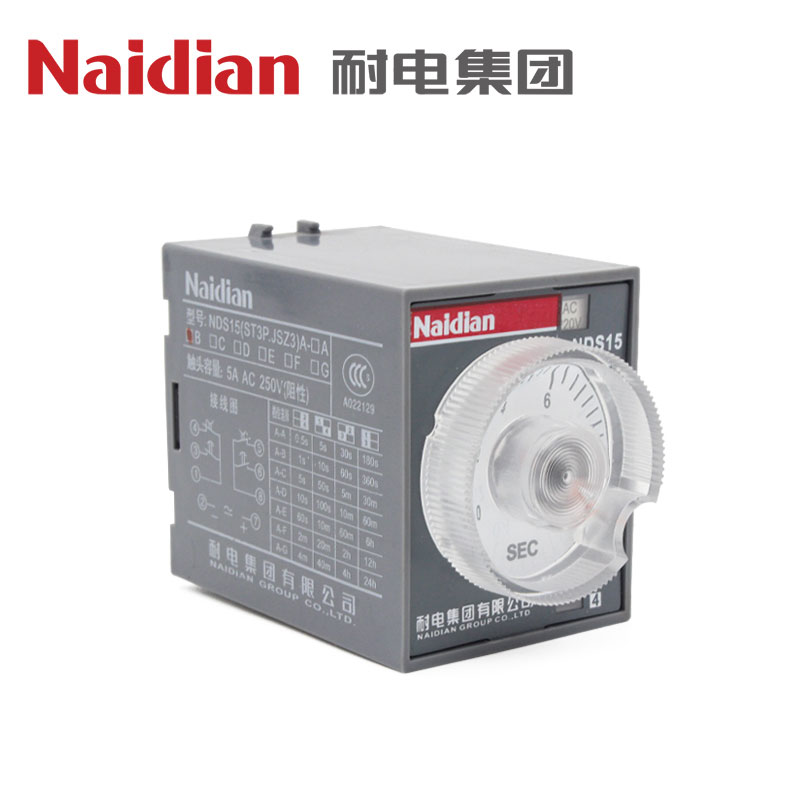
The NDS4‑P digital electronic time relay from Naidian offers a 0.1‑9999s delay range, AC/DC universal input, panel and rail mounting options, CE certification, and compliance with GB140485‑2000 and JB/T10047‑1999 standards. The NDS series includes power‑on, star‑triangle, repeat cycle, interval, and off‑delay models to match specific machine requirements. Contact ratings are 5A at 250VAC resistive and 3A at 220VAC inductive (AC‑15).
【Request a quote from Naidian】
Send Naidian your required delay range, supply voltage (AC/DC), load type (resistive or inductive), and mounting style (panel or rail) to receive an NDS series time relay specification and pricing for your control panel project.
