 English
 中文
中文 Pусский
 Español
 Português
 عربى
عربى

Why Choose a Microcomputer Protection Device?
You're upgrading a substation or specifying switchgear, and the decision comes down to protection—how do you detect faults quickly and reliably without filling a panel with bulky electromechanical relays? The answer is a microcomputer integrated protection device. It's a single, compact unit that replaces multiple traditional relays, offering digital accuracy, programmable settings, communication capabilities, and self-diagnostic functions. This guide explains what these devices do, where they're used, and what to look for when specifying one—straightforward and practical, with no unnecessary complexity.
The Core Function — Protection and Monitoring in One
A microcomputer protection device does two main jobs. First, it protects electrical equipment by detecting faults—overcurrent, short circuits, undervoltage, and more—and sending a trip signal to the circuit breaker. Second, it monitors the system continuously, recording data that helps operators understand what's happening in real time and diagnose issues after they occur.
Protection Functions
The device provides complete protection functions for feeders, transformers, motors, and capacitors. For line protection, it can be configured for incoming lines, outgoing lines, section protection, and line-transformer groups. Common protection elements include overcurrent, overvoltage, undervoltage, zero-sequence grounding, overload, and voltage loss.
Monitoring and Data Recording
Beyond protection, the device continuously monitors system conditions. A built-in clock with a backup battery ensures that even after power loss, the device can accurately record fault information with timestamps. This data is essential for post-event analysis and system optimization.
Where These Devices Are Used
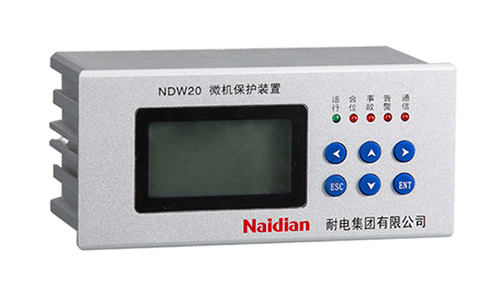
Microcomputer integrated protection devices are typically applied in power systems with voltage classes of 35kV and below. The NDW20 series, for example, is designed for 10kV and below. Common applications include substations, power plants, and switchgear.
Substations and Switchgear
In substations, these devices protect incoming and outgoing feeders, transformers, and bus couplers. Their compact, modular design makes them suitable for switchgear cabinets where space is limited.
Industrial and Commercial Facilities
Industrial plants, commercial buildings, and infrastructure projects with their own substations or distribution systems rely on these devices to protect critical equipment like motors and capacitors.
The Brains Inside — Hardware and Processing Power
The performance of a microcomputer protection device depends on its internal hardware. The NDW20 series uses a 32-bit high-performance processor capable of handling complex protection algorithms with speed and precision. High-precision resistive and capacitive components, along with sealed relays, ensure reliable operation across a wide temperature range.
Military-Grade Components
Wide-temperature military or industrial-grade chips are used to maintain performance in harsh environments. This matters in real-world installations where temperature fluctuations are common.
Redundant Watchdog System
To prevent system lockups, the device incorporates three watchdogs: an external hardware watchdog, a CPU hardware timer watchdog, and a software watchdog. This triple redundancy ensures the device won't freeze under any circumstances.
Communication and Integration Capabilities
Modern protection devices don't operate in isolation—they communicate with SCADA systems, remote control centers, and other intelligent electronic devices. The NDW20 series offers RS485/RS422 and CAN communication interfaces.
Protocol Support
The RS485 interface uses the Modbus-RTU protocol, selectable via configuration. The CAN interface supports the IEC60870-5-104 protocol, widely used in utility automation. High-speed magnetic isolation technology ensures stable, reliable communication even in electrically noisy environments.
Remote Monitoring and Control
With communication enabled, operators can monitor status, retrieve fault records, and control the device remotely—enabling unmanned substation operation.
Reliability Features That Matter
In protection applications, reliability is paramount. A device that fails to trip when it should—or trips when it shouldn't—can have serious consequences. The NDW20 series incorporates several features designed to prevent both scenarios.
Self-Diagnosis and Fail-Safe Lockout
The device has a complete self-diagnostic function. If it detects abnormal operation, it reliably locks the output, ensuring the device doesn't mis-operate.
Anti-Interference Design
The fully enclosed anti-interference unit case uses a new backplug structure with double-layer shielding and no external bus, reducing the impact of electromagnetic interference.
Switch Position Debouncing
Switch remote signals use dual-position acquisition to avoid the jitter problem commonly associated with switch operations.
Installation and Usability
A protection device is only useful if it can be installed, configured, and maintained efficiently. The NDW20 series addresses this with thoughtful design choices.
Compact Modular Design
The modular design results in a small footprint, making installation straightforward even in crowded switchgear cabinets.
User-Friendly Interface
A 128x64 dot matrix LCD screen with a full Chinese interface displays information in a multi-layer menu. The interface is intuitive enough that operators can complete debugging without complex training.
| Feature | Specification | Why It Matters |
|---|---|---|
| Processor | 32-bit high-performance | Fast, accurate fault detection |
| Voltage class | 10kV and below | Suitable for distribution systems |
| Communication | RS485 (Modbus-RTU), CAN (IEC104) | Integrates with SCADA and control centers |
| Watchdog | Triple redundancy (hardware + software) | Prevents system lockups |
| Case design | Fully enclosed, double-layer shielded | Resists electromagnetic interference |
| LCD display | 128x64 dot matrix, Chinese interface | Easy configuration and monitoring |
What Engineers Ask About Microcomputer Relays
What's the difference between a microcomputer protection device and a traditional relay?
A traditional electromechanical relay uses moving parts and coils to detect faults. A microcomputer device uses digital processing, offering greater accuracy, programmability, communication capabilities, and self-diagnostic functions—all in a much smaller package.
What voltage levels can these devices handle?
The NDW20 series is designed for 10kV and below. Other models in the broader category may support up to 35kV. Always check the specific device's rating for your application.
How do I choose between line protection, motor protection, and capacitor protection versions?
The NDW20 series includes dedicated variants: NDW20-L for line protection, NDW20-PD for capacitor protection, and a motor protection variant. Choose based on the equipment you're protecting.
What happens if the device loses power?
A backup battery maintains the real-time clock, so fault records retain accurate timestamps even after power loss. Configuration settings are stored in non-volatile memory.
Get the Right Protection for Your Substation
Specifying a microcomputer protection device doesn't have to be complicated. Start with your voltage level, identify the equipment you need to protect, and consider your communication requirements. Request a quote or technical consultation → —Naidian's team can help you select the right NDW20 series variant for your application.
This article was written with the assistance of AI to organise technical data from Naidian Group's product documentation and industry standards.
Naidian Group specializes in the development, manufacturing, and sales of relay protection and automation products. The NDW20 Series Distributed Microcomputer Protection Monitoring Device is designed on a fully decentralized "one device (one interval)" model for switchgear protection and monitoring. The series includes NDW20-L for line protection, NDW20-PD for capacitor protection, motor protection, voltage parallel, and standby power switching devices. All models feature a 32-bit processor, triple watchdog redundancy, RS485 (Modbus-RTU) and CAN (IEC104) communication, and a fully enclosed anti-interference case. Naidian's products are widely used in community power distribution, industrial facilities, and infrastructure projects. Contact Naidian to discuss your voltage class, protection requirements, and communication protocol needs.
